Healthcare Under Pressure: Three Lessons from the 2026 Healthcare Leadership Symposium
Jun 30 2026
Healthcare organizations are being asked to do more with less. Rising patient demand, constrained capital, workforce shortages, shifting care models, and accelerating technology investment have fundamentally changed how facilities are planned, funded, and delivered.
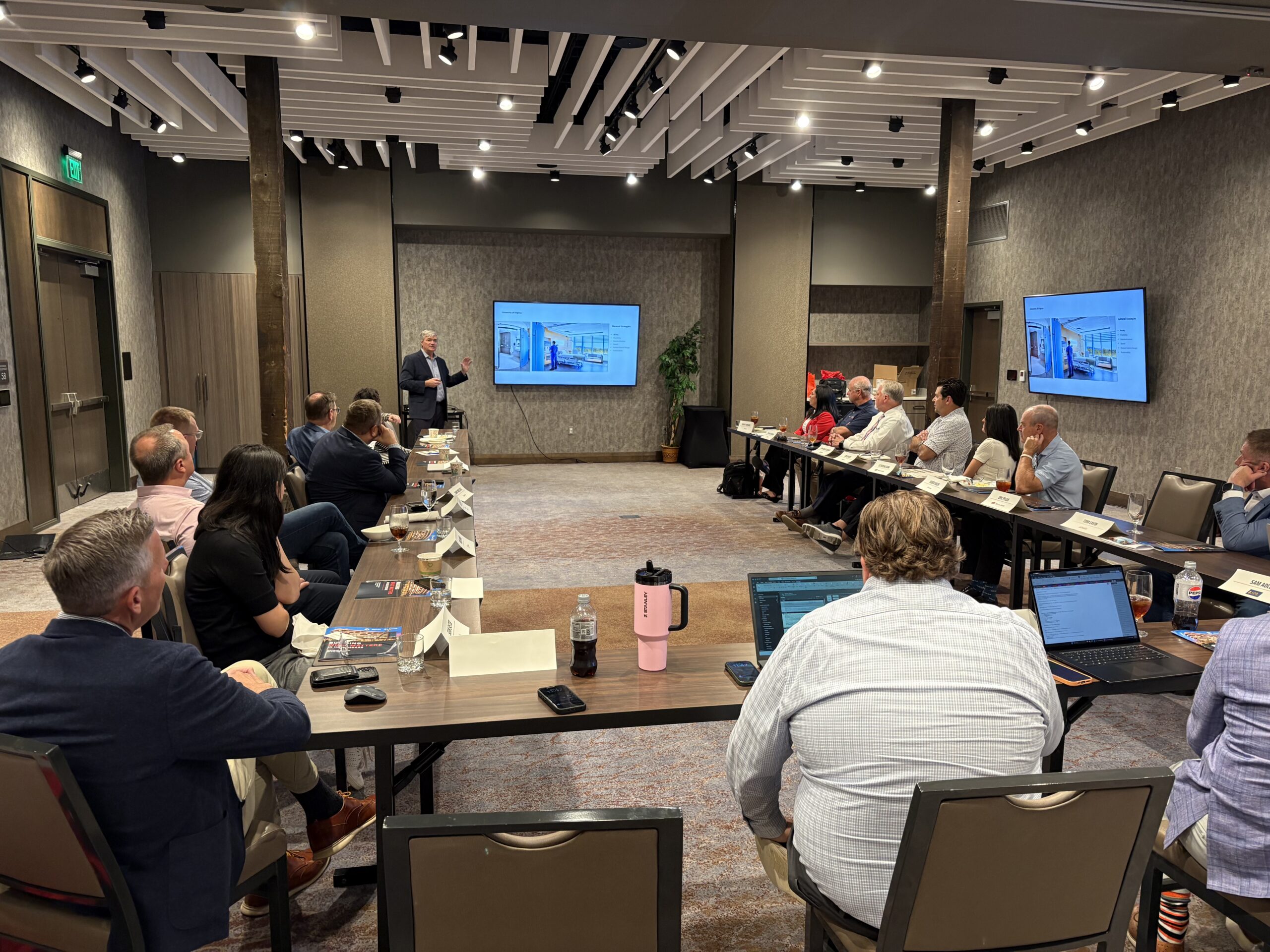
To explore what’s working and what isn’t, Flintco gathered CEOs, CFOs, healthcare planners, and design and construction leaders from health systems across the Midwest and Mountain West for the 2026 Healthcare Leadership Symposium in Memphis. The event focused on strategic growth, capital planning, Target Value Delivery (TVD), and the future of healthcare facilities. A tour and strategic overview of St. Jude Children’s Research Hospital rounded out the program, offering a rare look at how one of the world’s most mission-driven institutions manages significant growth while remaining focused on patient care and research excellence. Throughout the symposium, three themes emerged that apply to virtually every healthcare organization navigating today’s environment.
Mission and Long-Term Vision Must Drive Capital Investment Decisions
Since 2007, St. Jude Children’s Research Hospital has roughly doubled in size, adding major research towers, clinical facilities, family housing, and critical infrastructure upgrades—all guided by a rolling 10-year capital plan that leadership and the Board review and refine annually. At the center of it all is a singular mission: advancing research and treatment for children with catastrophic diseases. Every investment decision flows directly from that purpose.
That mission clarity is what makes the scale of growth sustainable. Capital decisions are not made in isolation but are filtered through long-term strategic intent. A defining feature of the model is its strong emphasis on outpatient and family-centered care. Rather than relying primarily on inpatient beds, patients and families stay in on-campus housing—ranging from apartment-style units for longer stays to hotel-style accommodations for families at different stages of treatment—with clinical services integrated throughout the campus. Each facility is deliberately shaped by the mission it serves.
Unlike most healthcare systems, St. Jude’s capital investments are funded almost entirely through philanthropy. Its fundraising arm, ALSAC, serves as the financial engine powering both research and clinical operations, enabling sustained investment in patient care and extending global impact. This funding model provides a level of long-term stability and flexibility that is uncommon in healthcare, further reinforcing the ability to align capital planning tightly with mission priorities.
Because of that stability, the institution is also able to plan for long-term growth in areas that extend beyond traditional care delivery. There is a rapidly increasing demand for data center capacity, power infrastructure, and advanced computing resources to support genomics, cancer research, and artificial intelligence initiatives. Future facilities are defined not only by clinical space but also by the digital and computational infrastructure required to support next-generation care and discovery.
The broader lesson for healthcare organizations is that capital planning is most effective when it is anchored to a clearly defined purpose. Organizations best positioned to navigate complexity and capital constraints use long-term strategic objectives as the filter for every investment. This allows them to focus resources on initiatives that advance their mission while delaying or eliminating those that do not. When capital requests are grounded in strategic purpose rather than isolated facility needs, they create stronger alignment at the executive and board levels and provide a more defensible path for investment.
That discipline is especially important in today’s financial environment. Many health systems, particularly faith-based and community-focused organizations, are absorbing significant levels of uncompensated care for uninsured and underinsured patients, while Medicare and Medicaid reimbursement often falls short of actual costs. The gap between mission and margin is real. In that context, capital decisions that are not anchored to a long-term vision not only underperform strategically—they also become increasingly difficult to justify.
Predictability and Transparency are Essential Requirements for Project Delivery
A featured session on Target Value Delivery challenged the traditional approach most healthcare organizations take to project planning. At its core, the concept is simple: treat cost as a design driver from the very beginning, not a constraint identified after schematic design.
In the conventional process, design comes first, with pricing following. That sequence often leads to predictable outcomes—budget overruns, scope reductions, repeated redesigns, and strained trust among stakeholders.
Target Value Delivery reverses that approach. Budget parameters are set early, and design evolves within those boundaries. The guiding principle is to “establish the sacred, challenge the rest.” Core requirements—such as bed counts, essential clinical programs, patient experience standards, and critical equipment—are defined and protected at project inception. Everything outside of that becomes an opportunity to refine and maximize value.
The St. Jude discussion reinforced this idea in a very direct way. It highlighted a deliberate shift toward setting scope and budget guardrails before design teams are fully engaged, recognizing that misalignment discovered late is far more costly than clarity established upfront.
Transparency is also central to the approach. High-performing teams don’t bury risk in a lump-sum budget; instead, they openly track contingencies, escalation allowances, and key decisions as the project develops. The emphasis isn’t on hiding uncertainty, but on managing it in real time and in the open.
Making this model work requires fully integrated teams. Owners, designers, contractors, trade partners, and end users stay engaged from the outset and continue that collaboration throughout the process. Continuous estimating, shared scenario planning, and collective accountability help reduce the redesign cycles that often drain both time and budget.
Speed to Market is Increasingly a Competitive Advantage
The shift toward outpatient and ambulatory care is actively reshaping how and where health systems compete. Healthcare systems are investing heavily in ambulatory care centers, freestanding emergency departments, and neighborhood clinics designed to improve access and engage patients earlier in the care continuum. In several cases, land is being acquired years in advance of construction, reflecting a clear understanding that real estate decisions made today will define market position for decades.
Bringing these facilities online faster, without compromising quality, has become a strategic imperative. The organizations doing this effectively aren’t cutting corners—they’re front-loading effort. Approaches gaining momentum include design-build delivery, standardized room templates and prototype designs, phased Guaranteed Maximum Prices, and the use of consistent project teams across multiple builds. The underlying principle: plan slow to go fast. Early clarity and alignment reduce delays and minimize costly redesign later in the process.
Technology is also playing a growing role in this transformation. Healthcare leaders are beginning to explore the use of AI in project management, administrative workflows, and decision-support tools. Adoption remains early, but the consistent message is that AI is intended to augment expertise, not replace it. Organizations that begin building familiarity now will be better positioned as capabilities continue to evolve.
Speed, however, brings infrastructure considerations that cannot be overlooked. The St. Jude discussion highlighted rapidly increasing demand for data center capacity, power infrastructure, and advanced computing resources to support genomics, cancer research, and AI-driven clinical applications. Future facilities will need to account for technological requirements that didn’t exist a decade ago and will only continue to grow. Organizations that treat digital infrastructure as an afterthought risk retrofitting buildings before they are even fully delivered.
What It Means for Healthcare Organizations Moving Forward
The symposium identified that organizations best positioned to succeed are those that combine strategic clarity with disciplined execution:
Mission drives investment decisions. The most effective capital plans aren’t simply financially sound—they’re rooted in a clear strategic purpose that guides priorities, aligns stakeholders, and provides a framework for difficult decisions.
Predictability creates value. Transparent budgeting, integrated teams, and early alignment reduce uncertainty, strengthen relationships, and build the confidence needed to invest again. Organizations that manage risk openly rather than react to it are better positioned to deliver successful outcomes.
Standardization accelerates delivery. Prototype designs, repeatable processes, and long-term partnerships create efficiencies that shorten schedules without sacrificing quality, allowing health systems to respond more quickly to changing market demands.
The future is outpatient, decentralized, and digital. Growth strategies must account for evolving care delivery models while also addressing the infrastructure required to support advanced technologies, data-intensive research, and AI applications.
Healthcare remains one of the most complex sectors to plan, fund, and build—and that complexity continues to grow. Yet the organizations approaching capital planning and project delivery with rigor, transparency, and a willingness to challenge conventional processes are finding ways to move forward, even in an increasingly constrained environment.
RELATED ARTICLES
You Bring The Vision.
We’ll Make It Happen.