Reliable Performance: Delivering Fully Operational Labs Through BIM Coordination
Jan 27 2025
Challenge
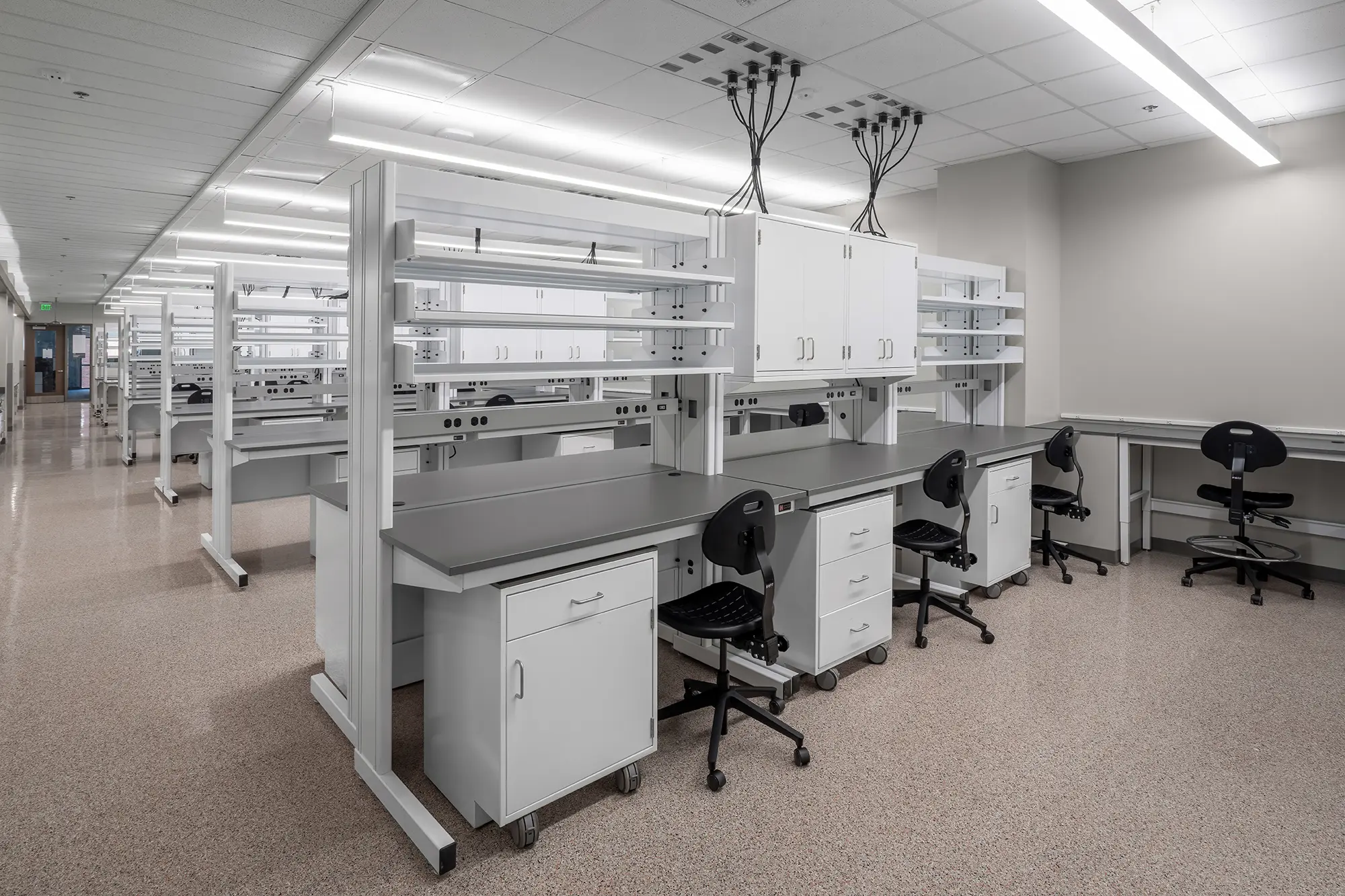
The Agricultural Hall at Oklahoma State University includes highly specialized laboratory systems to support cutting-edge research and teaching. Each lab relies on multiple, continuously operating MEP systems—including lab exhaust, fully ducted return, steam and chilled water, reverse osmosis lab water (RODI), vacuum, and compressed air—each serving specific processes within individual labs.
Coordinating and sequencing the installation and integration of each system was critical to ensure uninterrupted 24/7 operation. Hundreds of vertical penetrations through the concrete structure were required for specialized rooms and equipment, and every system’s placement had to be meticulously planned to fit within the building’s limited ceiling and wall spaces.
Solution
Flintco executed a BIM-driven strategy to coordinate the facility’s complex MEP infrastructure, dedicating eight months to ensure all trades could perform their work accurately. Under the guidance of Flintco’s BIM Manager, clash detection and coordination resolved hundreds of conflicts while reviewing every structural penetration in real time as the concrete structure was built. This process ensured precise system placement, minimized rework, and facilitated efficient installation.
Prefabrication of piping, insulation, and electrical assemblies complemented the BIM workflow, enabling crews to install complex systems safely and efficiently. Lab control systems were tested and balanced incrementally, confirming that each component functioned as designed without disrupting other systems.
Flintco also developed a federated model that combined all trades’ data to guide construction and provide the owner with a complete as-built model upon project completion.
Result
The Agricultural Hall’s MEP-based laboratory systems were delivered on time and under budget, with optimal performance from day one. BIM coordination and prefabrication minimized rework and optimized labor utilization, resulting in cost and schedule savings for Oklahoma State University. Each system operates seamlessly, responding dynamically to real-world conditions—for example, when a lab door opens, a Phoenix Valve automatically adjusts exhaust and negative-pressure settings, allowing the lab to continue operating safely and efficiently without disruption.
RELATED ARTICLES
You Bring The Vision.
We’ll Make It Happen.